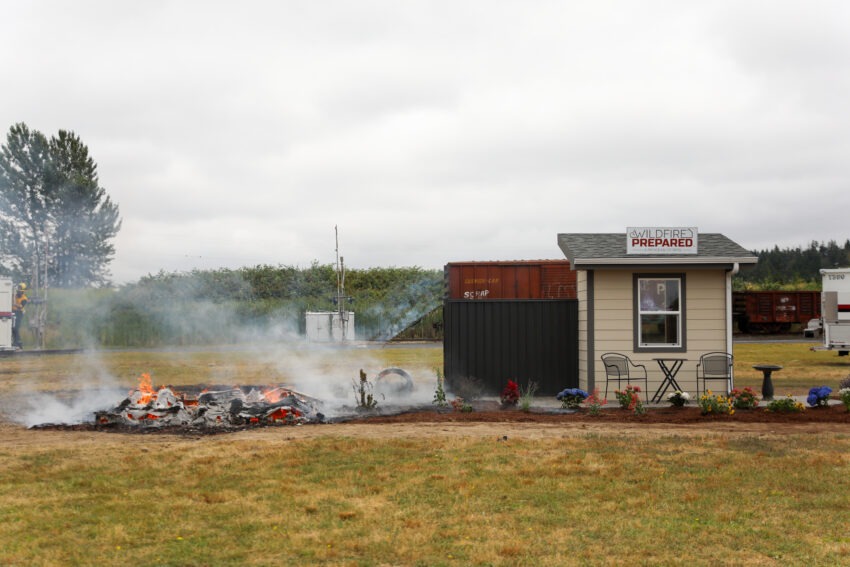
Five years ago, Senate Bill 762 set Oregon on a strategic course, one that recognized the realities of a growing wildfire crisis and invested in statewide systems to meet it. Yesterday, Fire Adapted Oregon and Response Ready Oregon marked their anniversary with a clear story: over the past five years, we’ve built a durable, statewide foundation for wildfire risk reduction and wildfire response, and we are scaling that work to meet Oregon’s evolving conditions.
This milestone is more than a date on the calendar. It’s a moment to reflect on what we’ve built together between local fire agencies, federal, state, and local partners, communities, legislators, and fire service professionals, and to share where we’re headed next.
FIRE ADAPTED OREGON: HELPING COMMUNITIES COEXIST WITH WILDFIRE
Fire Adapted Oregon was launched to help Oregon communities understand their wildfire risk, reduce hazards around homes, and strengthen local systems that keep people and neighborhoods safer. The program brings together education, mitigation, data, grants, and partnerships across multiple state agencies to support a cohesive statewide approach.
What We’ve Accomplished
Over five years, Fire Adapted Oregon has grown into a statewide initiative:
- 6,539 defensible space assessments completed statewide, and 502 trained defensible space assessors from 94 agencies
- Defensible space code created for local adoption, vetted through a comprehensive code adoption process
- Helping guide communities with best practices
- Expanded public education, including guidance on the first five feet, the ember‑vulnerable area closest to the home
- Strengthened partnerships, including a memorandum of understanding with the Insurance Institute for Business & Home Safety (IBHS) to connect science, data, and insurance collaboration
- A regional delivery model across nine districts, ensuring support is local, consistent, and scalable
- Significant investments through statewide grants, empowering local solutions (home hardening, mitigation, defensible space, and local capacity)
- A multi-agency Ridgetop to Rooftop Summit that gathered Oregon practitioners and leaders in the work of the cohesive strategy
- Focus group and partner feedback and collaboration to ensure programs are meeting the needs of local communities
- Hired a wildfire innovation manager working in the agency’s Center for Fire Analytics, Research, and Intelligence
Why This Work Matters
Wildfire risk in Oregon has grown dramatically. Conflagrations in 2020 reshaped what communities face, and just last year, the Rowena Fire resulted in 56 homes lost, a sobering reminder of the stakes. Wildfires are increasingly affecting our communities. In the West alone, wildfire destroyed 246% more homes and buildings between the last two decades (2010-2020 and 1999-2009) (Higuera, et al., 2023).
Fire Adapted Oregon’s work gives communities the tools they need to respond before a fire starts and address this new reality.
Where Fire Adapted Oregon Is Going Next
The next five years will focus on program scale, data, and durable systems:
- Expanded defensible space assessment training to add capacity to the program
- Continued and new grant programs, including community wildfire risk reduction and home hardening
- A multi-year communications strategy to educate Oregonians on home hardening and defensible space
- Continued scientific integration through partnerships like IBHS
RESPONSE READY OREGON: FASTER, MODERNIZED FIRE RESPONSE ACROSS THE STATE
While Fire Adapted Oregon programs reduce risk before a fire starts, Response Ready Oregon strengthens Oregon’s ability to respond when fires ignite. Built within the Oregon Fire Mutual Aid System (OFMAS), Response Ready Oregon increases capacity, modernizes equipment, and ensures that resources can be deployed rapidly and strategically.
What We’ve Built Together
Response Ready Oregon has delivered meaningful change for local departments and statewide readiness:
- Three all‑hazard incident management teams that support conflagrations, immediate response, and pre‑positioning assignments
- 76 new fire engines and tactical water tenders delivered to fire agencies statewide through the Engine Program
- Wildfire season staffing grants that boost seasonal and everyday response
- Regional mobilization coordinators statewide, connecting local chiefs to resources and support
- Placing resources ahead of high‑risk conditions (pre-positioning)
- Immediate response, sending the structural fire service to incidents to help stop growing and costly fires
Why It Matters
Oregon’s wildfire crisis demands fast, coordinated action. These programs mean:
- Increased staffing and equipment across local fire agencies
- Modernized and safer response tools
- More support for chiefs and local leadership
- Fires stopped while they are small, protecting lives, homes, and budgets
Where Response Ready Oregon Is Headed
Over the next five years, we’re focused on sustaining and expanding the most effective programs:
- Continued investments in wildfire season staffing grants, immediate response, pre‑positioning, and the Engine Program
- Stable, long‑term funding aligned with wildfire realities, as outlined in House Bill 3940
- Strengthening the fire defense board system with updated tools, technology, and efficiencies
- Statewide communications investments to improve interoperable systems and equipment
- Enhancements to technology systems, from statewide operating platforms to billing and mobilization integration
- Partnerships, memorandums of understanding, and interstate agreements to increase surge capacity
- Exploration of emerging technologies, such as low‑orbit satellites for real‑time situational awareness
Looking Ahead: A Stronger, Safer Oregon
In just five years, Fire Adapted Oregon and Response Ready Oregon grew from legislative vision to statewide systems that are changing how Oregon prepares for and responds to wildfire. Even with these sweeping changes, we know this work is just beginning.
The next five years will be about deepening impact, scaling what works, investing strategically, and ensuring Oregon’s communities and the fire service that protects them have the tools to meet today’s wildfire reality.
Oregon is stronger, safer, and more connected because of this work. Together, we’re building a future where every community is better prepared, every fire agency is better equipped, and every wildfire season is met with greater resilience.
Reference
Higuera, P. E., Cook, M. C., Balch, J. K., Stavros, E. N., Mahood, A. L., & A, L. (2023). Shifting social-ecological fire regimes explain increasing structure loss from Western wildfires. PNAS Nexus, 2(3). https://doi.org/10.1093/pnasnexus/pgad005